For the serious target shooter, a quality spotting scope is not a luxury; it is an essential piece of range gear. It allows you to see bullet holes and analyze shot groups from the bench without constantly walking downrange, saving immense time and effort. Whether you’re a competitive shooter fine-tuning a load or a hunter confirming a zero, the right scope brings the target up close and personal.
With so many models on the market, selecting the perfect one can be a challenge. This roundup cuts through the noise to present eight of the best spotting scopes for target shooting in 2025. We’ve considered factors like optical clarity, magnification range, durability, and value to help you make an informed decision for your shooting needs.
Our Top Picks for Target Shooting Spotting Scopes
- Vortex Optics Diamondback Spotting Scope 20-60×60 Angled
- Celestron – Ultima 80 Angled Spotting Scope – 20-60x Zoom
- Athlon Optics Ares UHD 15-45×65 Spotting Scope – 45 Degree
- Swarovski Optik ATS-65 HD Spotting Scope with 20×60 Eyepiece
- Konus KONUSPOT-80 20-60X80 Spotting Scope
- Nikon Prostaff 5 20-60×82 Spotting Scope
- Bushnell Trophy Xtreme 20-60×65 Spotting Scope
- Leupold SX-4 Ventana 2 20-60x85mm Spotting Scope
Vortex Optics Diamondback Spotting Scope 20-60×60 Angled
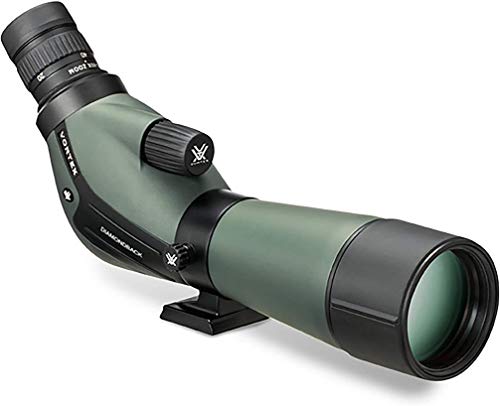
The Vortex Diamondback 20-60×60 is a superb choice for shooters who need high performance in a relatively light and compact package. Its XR fully multi-coated lenses are engineered for excellent light transmission, providing a clear and bright image that is crucial for seeing small calibers on paper at distance. This optical quality helps you accurately call your shots without leaving the firing line.
User-friendly features include a retractable sunshade to cut glare and a twist-and-lock collar that allows you to adjust the viewing angle for various glassing positions. The adjustable eyecup further enhances comfort during long sessions at the range, making this scope a practical and reliable tool for any shooting enthusiast.
Celestron – Ultima 80 Angled Spotting Scope
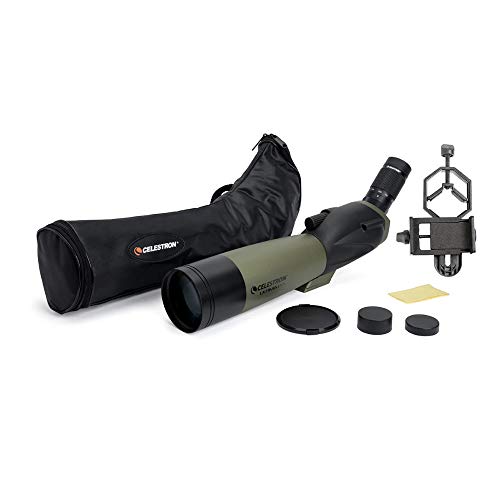
Celestron’s Ultima 80 offers outstanding value with its large 80mm objective lens, which gathers ample light for bright images even in overcast conditions. The multi-coated optics improve color and contrast, delivering sharp views that make it easier to distinguish shot groups. This scope is a great all-arounder for the outdoor enthusiast who also enjoys target shooting.
It comes as a complete kit, which is a significant advantage. You get an extended tripod mounting plate for stability, a soft carrying case, and a smartphone adapter for digiscoping. This allows you to easily capture images of your targets for later analysis or sharing with fellow shooters, adding a layer of functionality beyond simple observation.
Athlon Optics Ares UHD 15-45×65 Spotting Scope

The Athlon Ares UHD is built with advanced optics for the discerning shooter. Its apochromatic lens system and extra-low dispersion (ED) glass work in tandem to produce images with exceptional contrast, sharpness, and color definition. More importantly, this technology significantly reduces chromatic aberration, resulting in a clear, sharp image with little to no color fringing around the edges of your target.
A unique feature for this category is the interchangeable eyepiece. While the standard variable power eyepiece is excellent, you have the option to swap it for a fixed 22x eyepiece with a ranging reticle. This provides added versatility for shooters who may also use their scope for field applications where estimating distance is necessary.
Swarovski Optik ATS-65 HD Spotting Scope

For those who demand the absolute best in optical performance, the Swarovski ATS-65 HD represents the pinnacle of spotting scope technology. The fluoride-containing HD lenses are masterfully crafted to minimize color fringing and produce high-contrast images with stunning clarity. The difference in image quality, especially in challenging light, is immediately noticeable.
The angled body design is not only comfortable for observing birds in the air but also ideal for target shooting when the scope is mounted on a tripod. It allows for a more natural head and neck position, reducing fatigue during long range sessions. This scope is an investment in unparalleled optical excellence and long-term durability.
Konus KONUSPOT-80 20-60X80 Spotting Scope

The Konus KONUSPOT-80 provides a substantial 80mm objective lens, offering a great balance of power and light-gathering capability for the budget-conscious shooter. This larger aperture is beneficial on dim days or in early morning light, ensuring your view of the target remains bright enough to clearly see your shot placement.
With a variable magnification from 20x to 60x, this scope gives you the flexibility to zoom in for a detailed look at a single bullet hole or zoom out to assess an entire shot group. It is a solid, no-frills option that delivers the core functionality needed for effective target observation at an accessible price point.
Nikon Prostaff 5 20-60×82 Spotting Scope
Nikon brings its renowned expertise in optics to the field with the Prostaff 5. The large 82mm objective lens is the standout feature, designed to maximize light transmission for a bright and clear view, which is essential for spotting small calibers on paper targets at high magnification.
This scope incorporates Nikon’s premium ED glass, which effectively reduces chromatic aberration. The result is a high-resolution image with true-to-life color and sharpness, allowing for precise analysis of your shooting. The ergonomic design and smooth zoom mechanism make it a pleasure to use during extended sessions on the range.
Bushnell Trophy Xtreme 20-60×65 Spotting Scope
Built with the hunter and shooter in mind, the Bushnell Trophy Xtreme is designed to perform in tough conditions. It is both fog-proof and waterproof, ensuring reliability no matter the weather you encounter at the range. The EXO Barrier protection on the lenses repels water, oil, and dust, making maintenance simple.
Optically, it offers a sharp, multi-coated view that helps you clearly see your hits. The 65mm objective lens provides a good balance between size and performance, making it a portable yet capable partner for confirming your rifle’s zero or checking targets during a competition.
Leupold SX-4 Ventana 2 20-60x85mm Spotting Scope
The Leupold SX-4 Ventana 2 boasts a massive 85mm objective lens, the largest in this roundup. This superior light-gathering ability provides an exceptionally bright image, which can be a critical advantage during early morning, late evening, or in heavily shaded shooting bays where light is limited.
Leupold’s proprietary Twilight Max HD light management system ensures you get the clearest and brightest view possible by maximizing light transmission and reducing glare. Combined with its rugged, waterproof construction, this spotting scope is a top-tier tool for the serious long-range shooter who cannot compromise on optical performance.
What to Look For in a Spotting Scope for Target Shooting
Choosing the right spotting scope for target shooting isn’t just about grabbing the most expensive one you see. It’s about matching the tool to the specific job of seeing tiny holes on paper or hearing the satisfying ‘ping’ on steel from far away. I’ve spent a lot of time behind a scope, and here’s what I always check for.
First, magnification is a big one. For most rifle ranges, especially out to 300 yards, a scope that goes up to 45x or 60x is plenty. Any higher, and the image can get shaky and fuzzy without a seriously solid tripod. I find a zoom range like 15-45x or 20-60x gives me the flexibility I need. The objective lens size, which is the second number (e.g., 60 in 20-60×60), dictates how much light gets in. A larger objective lens, like 80mm, is fantastic for low-light conditions, but it also makes the scope bigger and heavier. For sunny day shooting, a 60mm objective is often perfectly adequate.
Next, let’s talk about the glass itself. This is where you really get what you pay for. Fully multi-coated lenses are non-negotiable for me. They reduce glare and increase light transmission, giving you a brighter, clearer, and sharper image. This clarity is what allows you to see .22 cal holes in black targets or trace your bullet’s path through mirage. The prism type also matters. Roof prism scopes are more compact and streamlined, while Porro prism scopes often offer a wider field of view for the same price, which can be helpful for scanning a full target line.
Durability is another critical factor. A spotting scope for the range gets handled, bumped, and exposed to the elements. Look for a scope with a rugged, rubber-armored body that provides a good grip and protects against minor impacts. It should also be nitrogen-purged and O-ring sealed to be waterproof and fog-proof. There’s nothing worse than having your view ruined by internal fogging on a cold morning.
Finally, don’t forget the practical stuff. The focus knob needs to be precise and smooth for making fine adjustments. A locking collar is a small feature that makes a huge difference, preventing the scope from accidentally drooping on your tripod. And speaking of tripods, a good, stable tripod is just as important as the scope itself. A wobbly tripod will make even the best spotting scope useless. When I’m picking out the 8 best spotting scopes for target shooting, these are the core features I’m always evaluating to ensure you get a tool that truly performs.
Frequently Asked Questions
What magnification do I realistically need for seeing .223 holes at 100 yards?
For seeing .223 caliber holes in a black target at 100 yards, you can usually manage with around 25x to 35x magnification, provided the optical quality of your spotting scope is good. However, if the light is poor or there’s a lot of mirage, you might need to push it to 40x or higher. The key is having sharp, high-contrast optics. A cheap 60x scope will often show a blurrier image than a high-quality 35x scope. For consistent results, I recommend a scope that can comfortably reach the 40-45x range.
Is an angled or straight spotting scope better for the shooting bench?
This is largely a matter of personal comfort, but each has its advantages. An angled eyepiece is often easier on your neck, especially during long sessions, because you can set the tripod lower and look down into the scope. It’s also easier to share with other shooters of different heights. A straight-body scope is often simpler to point at the target quickly and can be a bit more comfortable if you’re mostly shooting from a prone position. I prefer angled models for benchrest shooting because they save my back and neck.
Why is a tripod so important for a spotting scope?
A tripod is not just an accessory; it’s a fundamental part of your spotting scope system. At high magnifications, even the slightest movement is amplified, making the image jump around and impossible to see fine details like bullet holes. A sturdy, stable tripod eliminates this shake, allowing you to use the full power of your scope’s magnification effectively. A flimsy tripod will make a top-tier scope perform like a cheap toy. It’s one of the most common mistakes I see new shooters make.
Can I use a spotting scope for other activities besides target shooting?
Absolutely. A quality spotting scope is incredibly versatile. I use mine for birdwatching, wildlife observation, and even as a super-telephoto lens for digiscoping (taking photos through the eyepiece). The same features that make a scope great for target shooting—clear optics, high magnification, and durable construction—also make it perfect for these hobbies. If you think you might use it for more than just range days, it’s a worthwhile investment.
What’s the difference between a spotting scope and a rifle scope?
While they both magnify a distant object, they are designed for completely different jobs. A rifle scope is mounted directly to your firearm and needs to withstand recoil. Its reticle is used for aiming. A spotting scope is a standalone observational tool used to see your hits on the target without having to walk downrange. It typically offers much higher magnification than a rifle scope and is mounted on a tripod. You should never use a spotting scope as a riflescope. When selecting from the 8 best spotting scopes for target shooting, you’re choosing a tool specifically for observation and analysis, not for firing a weapon.